


If you're not in the healthcare industry, you may have never heard of Medline.But for many publicly listed medical consumables companies in China, Medline is a name that appears again and again in annual reports—often as one of their largest customers.I've been following Medline for years. Not because it manufactures the most advanced products, nor because it has the strongest brand recognition among the public, but because it has built something far more powerful: a system that has become deeply embedded in how hospitals operate.This article is simply my personal perspective on why Medline has been so successful, and why its path is one that I find particularly compelling.
1. Medline Doesn't Sell Products — It Sells a System
Founded in 1966, Medline has spent decades focusing on one core mission:
Helping hospitals make as few decisions as possible about non-core medical supplies.
Its business is not built around a single breakthrough product or a flagship technology.
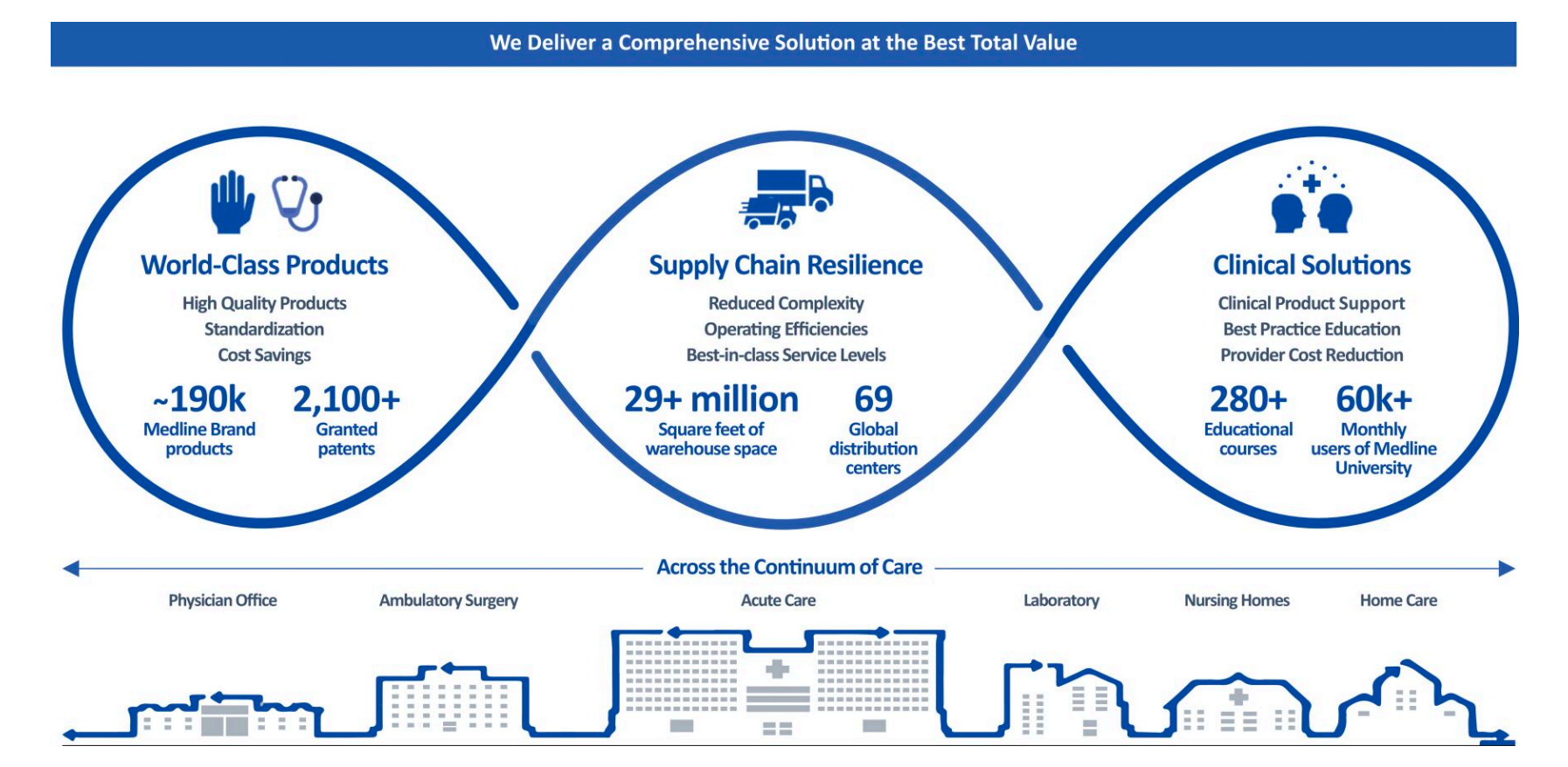
Instead, Medline supplies the everyday essentials that hospitals rely on to operate:
Procedure and surgical kits
Personal protective equipment (PPE)
Patient room consumables
Nursing and infection prevention products
What these categories have in common is simple:
High-volume usage
Essential to daily operations
Required regardless of economic conditions
These are not the products that make headlines. They are the products that keep hospitals running every single day.
And that's exactly where Medline has built its advantage.
This is also one of the reasons why I strongly identify with Medline's approach.
In my view, what truly determines hospital efficiency is often not the most advanced medical equipment, but the underlying systems that are used every day and simply cannot afford to fail.
2. The Real Moat Is Switching Costs, Not Technology
Many people assume that Medline's advantage comes from its massive number of SKUs. But those inside the industry know that SKUs have never been the real barrier to entry. The real barrier is the system behind them.
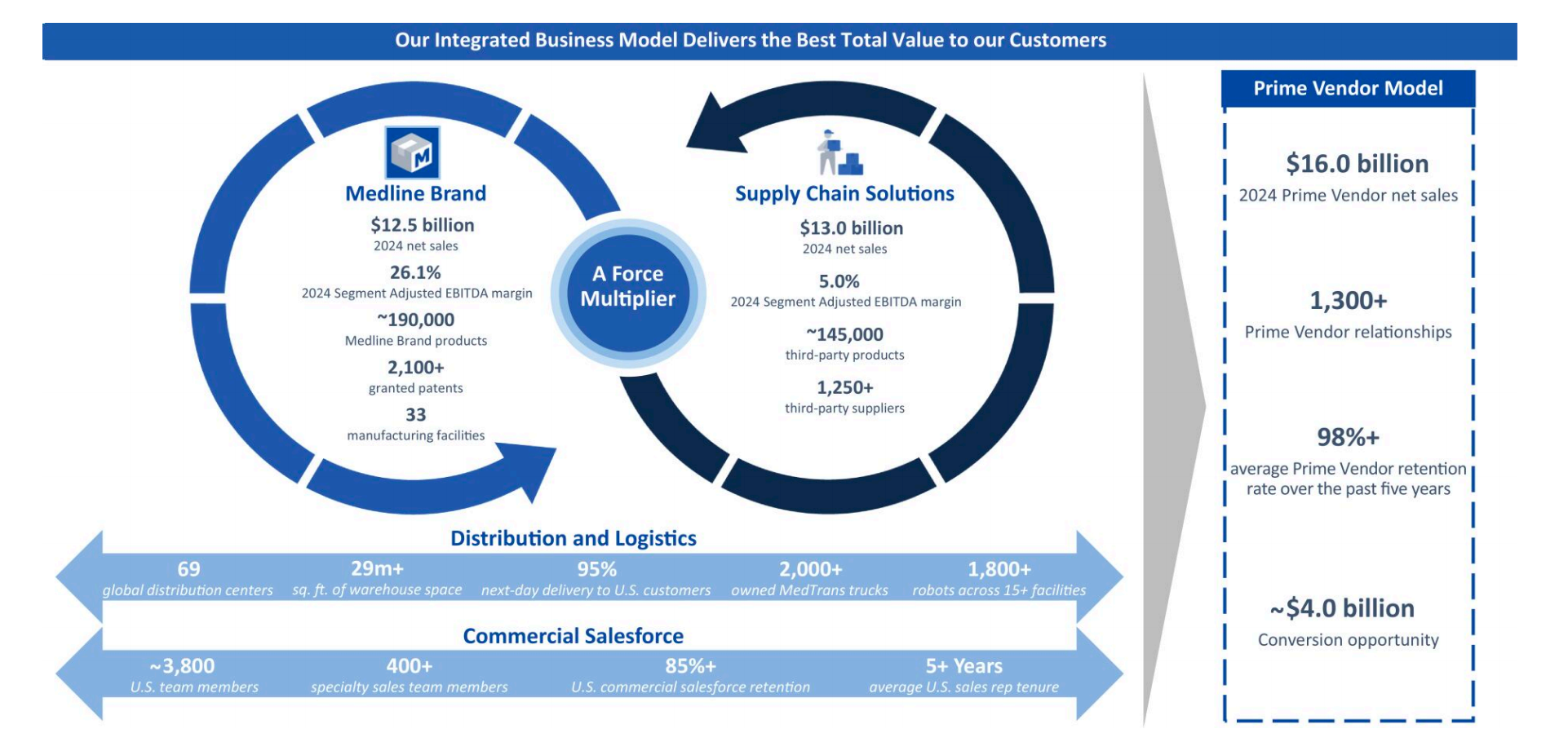
Medline combines:
One-stop sourcing
Private-label products and OEM integration
Reliable delivery
Deep service integration
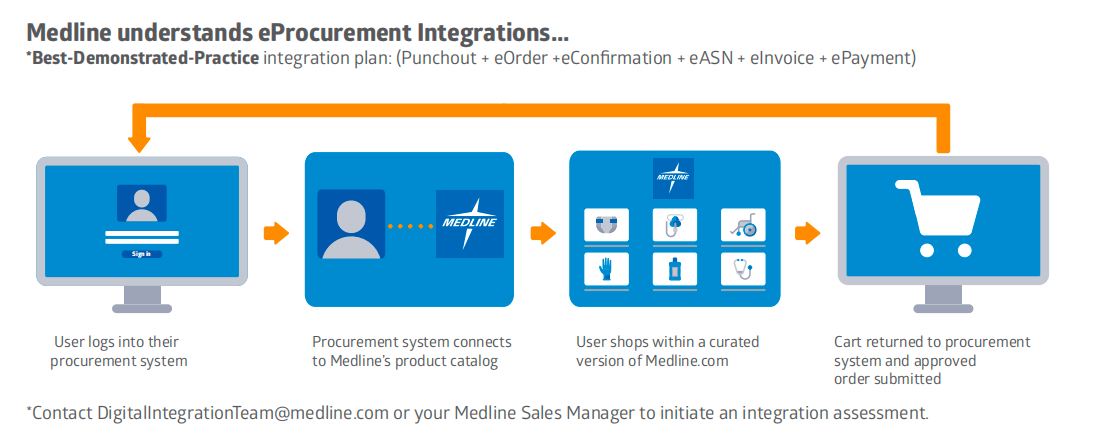
Once a hospital entrusts its inventory management, supply replenishment, and day-to-day consumables to a single system, switching to another supplier becomes far more difficult than simply changing products—it often means rebuilding established workflows.
This is one of the reasons why Medline has maintained customer retention rates of around 98% for many years.
This kind of system-driven stickiness is something I personally find particularly compelling, and it is a direction I continually think about and test in my own business.
3. Why Medline Resembles Costco — and Why I Agree
Medline's management has often described the company as the "Costco of healthcare," and I personally think that comparison is quite accurate.
The two companies are built on a remarkably similar foundation:
They do not rely on high-margin flagship products.
They create advantages through scale, operational efficiency, and trust.
Their private-label brands are a core driver of long-term profitability.
The more I study companies like Medline, the more convinced I become of one idea:
The future of medical consumables may not belong to the company with the most advanced technology, but to the one that can deliver essential products with the highest level of reliability and consistency.
4. A Naturally Counter-Cyclical Business
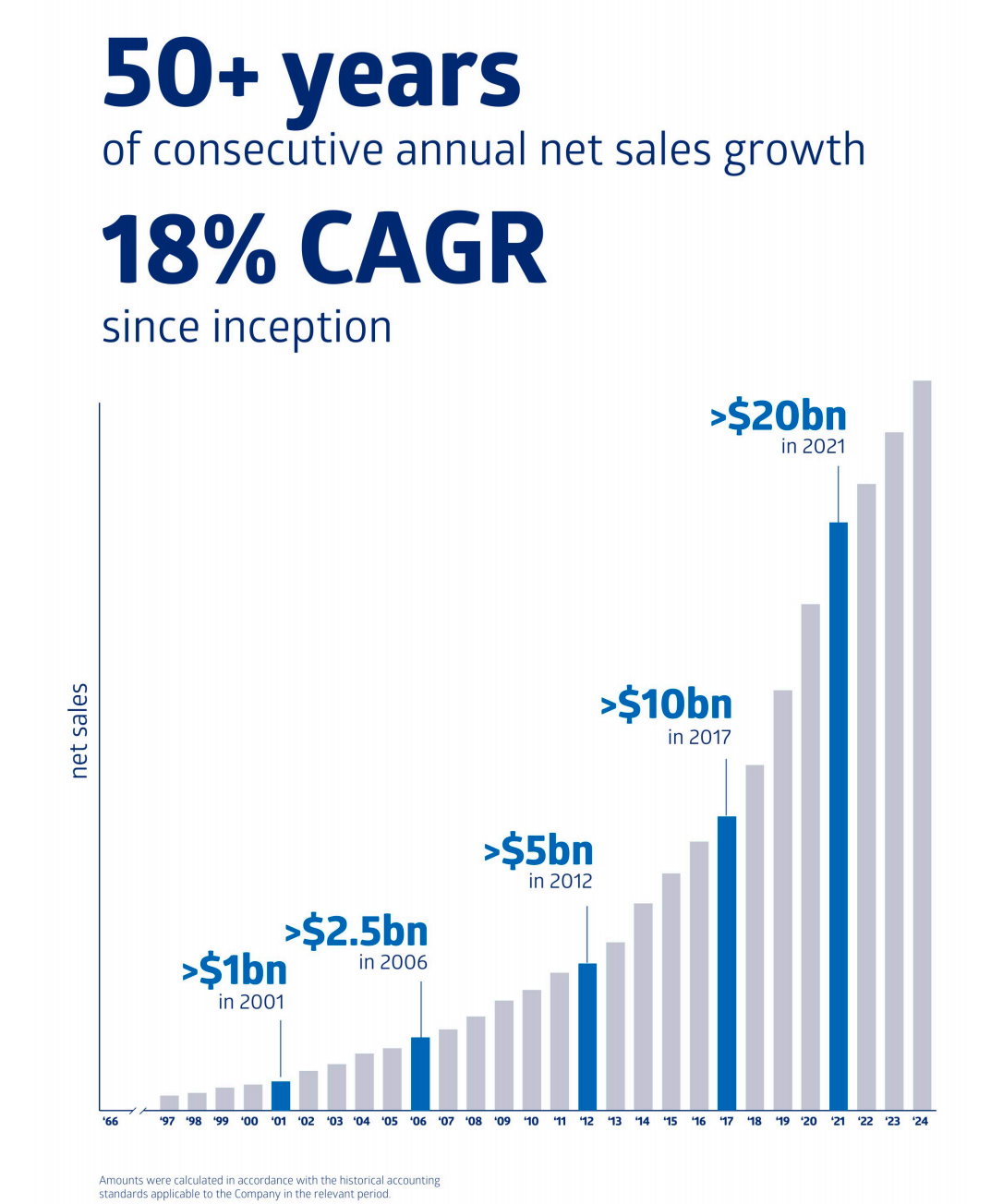
How has Medline managed to grow continuously for more than 50 years?
The answer is surprisingly simple:
Hospitals cannot stop operating.
Medical consumables cannot be interrupted.
The more challenging the economic environment becomes, the more healthcare providers need to reduce system-wide costs.
This is one of the reasons I find this sector so compelling.
It is not a fashionable industry, nor is it driven by short-term trends. But it is built on long-term demand and enduring necessity.
5. The Reality: This Is Not an Easy Business
That said, it is important to acknowledge that this is not a glamorous industry.
Profit margins are generally modest.
Success depends heavily on supply chain management, cash flow discipline, and operational execution.
Mistakes in any part of the system tend to be amplified quickly.
Medline itself faces challenges, including cost pressures, debt obligations, and uncertainty in the broader operating environment.
What has enabled the company to succeed over decades is not explosive growth, but the accumulated strength of a resilient operating system.
Final Thoughts: Why I Continue to Follow Medline
If I had to summarize Medline in one sentence:
Medline is one of the least glamorous, yet most worthwhile healthcare companies to study.
Not because it is perfect, but because it proves a fundamental principle:
In healthcare, long-term success is built on the ability to deliver essential needs with exceptional consistency and reliability.
I am also trying to build something guided by a similar philosophy—a more systematic and long-term approach to medical consumables.
Not by benchmarking its scale, but by learning from its logic and the path it has taken.